
Understanding Fire Ant Colony Behavior on Open Land
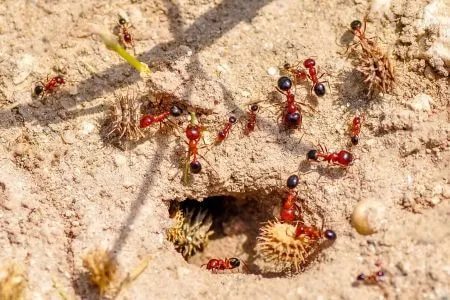 A fire ant mound may look like the entire problem, but most of the colony is hidden below the surface. That matters on acreage, where dozens of colonies can develop across pastures, fields, fence lines, pond edges, and other open areas before the landowner realizes how widespread the activity has become. Understanding fire ant colony behavior on open land makes it easier to see why chasing visible mounds is often frustrating and why large properties benefit from a broader, scheduled control program.
Fire Ant Specialists work with Florida farms, ranches, residential acreage, parks, nurseries, and other large properties where fire ant colonies can spread far beyond the areas people visit every day.
Why Do Fire Ants Prefer Open Land?
Red imported fire ants are remarkably adaptable, but open, sunny ground suits them especially well.
Fire ants commonly establish colonies in pastures, lawns, meadows, parks, and cultivated fields. They can live in many types of soil and also appear around trees, stumps, structures, and other protected locations.
Large Florida properties offer plenty of what colonies need: warmth, moisture, open soil, food, and room to expand.
Fire Ant Specialists frequently finds activity around:
- Pastures and grazing areas
- Fence rows
- Barns and outbuildings
- Ponds and retention areas
- Dirt roads
- Equipment zones
- Irrigated ground
- Watering and feeding areas
On several acres, some of those colonies may remain unnoticed simply because nobody walks through that particular section of land very often.
How Large Can a Fire Ant Colony Become?
Much larger than the mound suggests.
A mature colony can contain tens or hundreds of thousands of workers. The visible mound is essentially the top of a much more complicated underground system.
Workers maintain the nest, care for developing broods, gather food, and protect the queen. The queen’s primary role is reproduction. Once a colony is established and well supplied, she can produce hundreds of eggs each day.
That constant replacement of workers is one reason surface activity can return quickly when a control method affects only the ants seen above ground.
Do Fire Ant Colonies Stay in One Place?
Not necessarily. Fire ants can relocate when conditions change.
Colonies may move vertically or horizontally within the soil in response to temperature, drought, or flooding. Entire colonies can also migrate to a different location.
Heavy Florida rain creates another interesting behavior. When floodwater reaches a colony, the ants can leave the nest together and form a floating mass until they encounter dry ground. Once there, they can begin establishing themselves again.
For a landowner, that means seeing new mounds after a period of heavy rain does not necessarily mean the problem appeared overnight from nowhere. The ants may simply have moved.
How Do New Colonies Start?
Fire ants also spread through mating flights. Winged reproductive ants leave established colonies, often following rainy periods. After mating, fertilized queens land, shed their wings, and look for suitable ground where they can begin a new nest.
The first colony starts small. The queen initially raises the first generation herself. Once those early workers mature, they begin gathering food and caring for later generations.
Within months, the colony can contain thousands of ants and produce a mound large enough to become noticeable. This is one reason even well-managed acreage remains vulnerable to new activity from surrounding land.
Control is an ongoing process rather than a one-time event.
Why Does Fire Ant Foraging Matter for Treatment?
Worker behavior is central to professional bait programs.
Fire ants leave the colony to search for fats, proteins, sweets, insects, and other food sources. Once workers find suitable food, they recruit additional ants and transport material back to the colony. Professional broadcast bait takes advantage of that behavior.
Fire Ant Specialists broadcast a food-like granular bait across the treatment area so actively foraging workers can encounter it and carry it back underground. The company’s approach focuses on disrupting queen reproduction so that the colony gradually declines as existing workers reach the end of their natural life cycle.
That is very different from treating only the top of a visible mound. On open land, the workers themselves help carry the treatment into colonies that may otherwise be difficult to locate.
Understanding Fire Ant Colony Behavior on Open Land Helps Improve Control
Understanding fire ant colony behavior on open land explains why large-property control requires more than reacting to whatever mound appears next. Colonies remain mostly underground, move when conditions change, establish new nests through mating flights, and can exist at very high densities where multiple queens are present. Their natural foraging behavior also creates an opportunity to reach colonies across broad areas through properly timed broadcast treatment.
Fire Ant Specialists has decades of experience treating Florida farms, pastures, residential acreage, parks, nurseries, and other large properties. Instead of spending your time searching fields for the next mound, call Fire Ant Specialists at 352-291-2687 or request a free estimate to discuss a long-term fire ant control program for your property.
Custom Application
Service Guaranteed
We use a safe and effective process that will eliminate the worry of fire ants from your farm, nursery, home or business.
With just 2-3 treatments per year and our guarantee results, we can establish and sustain a great fire ant control program for your property. Our system works deep to get at fire ants you can’t see. Not only will you save a lot of money, you will believe that fire ants can be controlled.

And the guarantee is simple:

If our service does not work within the time frame specified to you at the time of application, we will spot treat the area of infestation at no charge.
Looking for
Fire Ant Specialists
Specialists in Florida?
We welcome your questions and will provide an estimate upon request.
Simply fill out the information to the right or call us Monday thru Friday, from 8:00 am to 4:00 pm.


Request a
Free Estimate
Send us a request. Our treatment is fast, affordable, effective, and guaranteed.